
There's a reason it keeps happening.
And it's unlikely to be the one you've been telling yourself.
Binge eating disorder and compulsive overeating are among the most misunderstood eating difficulties there are - and among the most treatable, with the right support. This page is for anyone who recognises the pattern, whether or not they have a name for it.
People who find their way to this page often describe a similar experience with food and eating. The details vary but the underlying pattern tends to be fairly consistent.
They have episodes of eating that feel out of control - where eating is fast, often in private and often well past the point of fullness. Afterwards comes a wave of shame, self-criticism and resolve to do better. For many this is a familiar pattern that has been going on for years, sometimes decades.
They have tried cutting back, starting fresh and following plans but nothing has made a lasting difference. Some have lost weight and regained it more than once. And most have spent a long time believing the problem is their lack of willpower, their discipline or ultimately, just them.
When someone who binge eats chooses to seek support, it is often the result of a gradual accumulation of exhausting feelings and experiences. Whilst they might be quietly wondering whether this is just how things are going to be - it doesn't have to be.
What is binge eating disoder?
Binge eating disorder (BED) is the most common eating disorder in the UK and one of the least talked about. It's characterised by recurrent episodes of eating large quantities of food in a short period of time, with a sense of loss of control during the episode and significant distress afterwards.
Unlike bulimia, BED doesn't typically involve compensatory behaviours such as purging or fasting. But it almost always exists within a longer pattern - one where attempts to restrict food, eat more carefully or follow a plan trigger the very urges they're trying to manage.
BED affects people across all body sizes, ages and backgrounds. It is a recognised clinical condition with well-understood neurobiological underpinnings. It is definitely not a lifestyle choice, a character flaw or a failure of self-control.

A formal diagnosis isn't required to seek support. Many people who experience binge eating don't meet the full clinical criteria for BED - but their struggle is just as real and just as deserving of proper attention.
One of the most important things to understand about binge eating is that restricting food - even gentle, well-intentioned restriction - tends to make it worse over time.
When the body experiences food scarcity, whether through a formal diet, skipping meals, eliminating food groups or simply eating less than it needs, it responds at a neurobiological level. Food preoccupation increases. Cravings intensify. The brain's reward system becomes primed to seek out precisely the foods that have been avoided. This is a physiological response that has been well-documented in research.
The cycle tends to follow a recognisable shape:
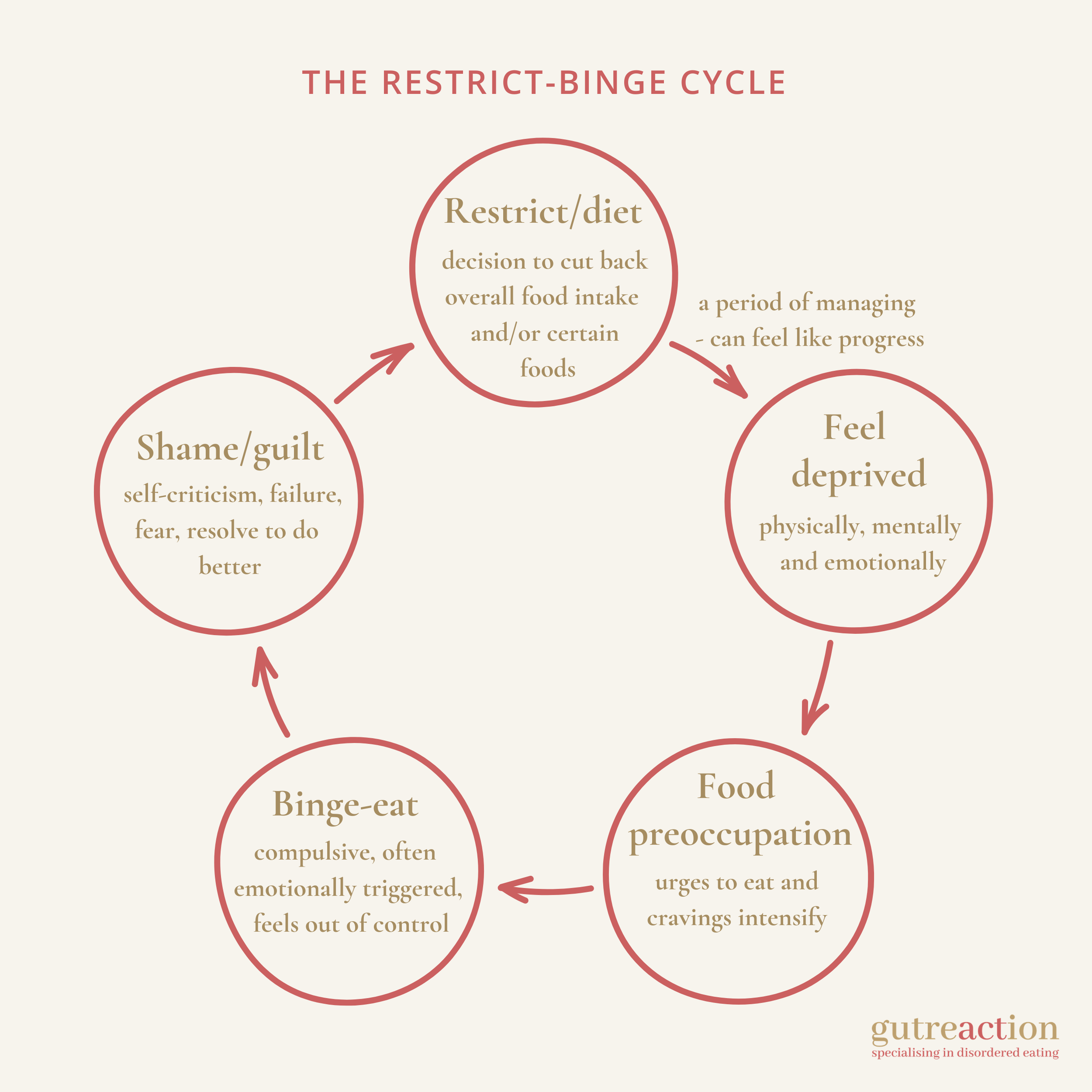
– A decision to eat differently - restrict, cut back, follow a plan
– A period of managing - which can feel like progress
– Increasing preoccupation with food, intensifying urges
– An episode of overeating or bingeing
– Shame, self-criticism, renewed resolve
– Restriction again - and the cycle begins once more
Each time the cycle repeats, it can become more entrenched and harder to step out of. This is why more effort, more discipline or a better diet plan rarely resolves the problem. What tends to make a lasting difference is understanding what is driving the cycle, and then working with the body rather than against it.
““Still amazed at how my habits have changed but now with very little conscious thought around it all. I haven’t binged or emotionally eaten for a very long time.””

A specialist approach
I'm Sarah Grant, founder of Gut Reaction. I'm a BANT Registered Nutritional Therapy and Behaviour Change Practitioner, a Certified Intuitive Eating Counsellor, and one of a small number of practitioners in the UK to hold Advanced Practitioner accreditation in Nutritional Therapy for Eating Disorders.
I've been working clinically with binge eating disorder, compulsive overeating and disordered eating for over twelve years.
The work I do isn't a diet, a meal plan or a programme of food rules. It's a collaborative, evidence-informed process of understanding what's driving a person's eating patterns - nutritionally, psychologically and behaviourally - and building a relationship with food that is genuinely more sustainable, without the constant effort of trying to manage or control eating.
My approach draws on nutritional therapy, Intuitive Eating counselling, Acceptance and Commitment Therapy and the latest in body image research, brought together through my own clinical framework - The 7 Dynamics of a Healthy Relationship with Food and Your Body.
Understanding the nutritional and neurobiological factors driving binge eating - what's happening in the body, not just the mind
Restoring regular, nourishing eating patterns that reduce the physiological drivers of bingeing
Identifying and working with the emotional, psychological and behavioural triggers involved
Gradually rebuilding self-trust and a less fraught relationship with food and the body
Developing ways of eating that don't depend on rules, restriction or willpower to maintain
REFOCUS
2-months
Refocus is ideal if you want focused support with one or two specific challenges in your relationship with food. This programme offers clarity, direction and practical support where it is needed most, helping you re-ground your approach to nourishment and make meaningful changes over a shorter period of time.
A preliminary 2-hr Mind.Body.Food Review to explore and prioritise your needs
3 consultations (1-hr each), spread 2-3 weeks apart
Plus more - see ALL the below*
£290/month for 2-months (£580 in total)
RECONNECT
4-months
Reconnect is designed for those seeking a deeper, more comprehensive process of change. As my signature programme, it supports you across all seven dynamics of a healthy relationship with food and body, allowing time to stabilise eating patterns, build self-trust and strengthen supportive habits.
A preliminary 2-hr Mind.Body.Food Review to explore and prioritise your needs
2 consultations (1-hr each) per month, with weekly check-ins
Plus more - see ALL the below*
£350/month for 4-months (£1,400 in total)
REALIGN
9-months
Realign is suited to those who know they need longer-term support to work with their health, habits and relationship with food and body. The extended timeframe allows change to unfold at a manageable pace, offering flexibility for busy lives and space to consolidate progress over time.
A preliminary 2-hr Mind.Body.Food Review to explore and prioritise your needs
2 consultations (1-hr each) per month during the first 4-months, then 1 per month during the subsequent 5-months, with regular check-ins in-between
Plus more - see ALL the below*
£250/month for 9-months (£2,250 in total)
“ “My eating habits were chaotic, food was often used as an emotional crutch and I was feeling very negative about myself, my body and my choices. Since working with Sarah I feel empowered and confident to make choices that satisfy me and make me feel good.” ”
““Safe to say Sarah has had a hugely positive impact on not only my health but my outlook on nutrition, life and wellbeing.”
”
““Sarah has a really special approach. She wants to know about you, your life, your habits, your emotions before discussing your diet. Actually, she won’t give you a diet, she will give you an opportunity to change your life.””
Follow your GUT,
not a diet plan
I’m a BANT Registered Nutritional Therapy Practitioner (DipNut, mBANT, rCNHC) and Certified Intuitive Eating Counsellor with over twelve years’ clinical experience.
One of a small number of practitioners in the UK to have completed Advanced Practitioner training in Nutritional Therapy for Eating Disorders, I understand the full spectrum of disordered eating.
A peaceful relationship with food is not achieved by following diet plans - ultimately it requires you to build trust in your body and in yourself. Let me help you on your path towards a life filled with more vitality, and physical, mental and emotional freedom around food and your body.
Imagine having a more peaceful, trusting relationship with food and your body…
~ Going through your day with food taking up less mental space - eating when you’re hungry and enjoying food without constant overthinking or second-guessing
~ Feeling more attuned to your body and confident making food choices that genuinely support your energy, satisfaction and wellbeing
~ Supporting your body and mind with nourishing routines that feel realistic and sustainable, and prioritising self-care without guilt
~ Regaining time and mental energy previously spent on food rules, self-monitoring or the scales, and focusing more on what really matters in your life
~ Noticing critical self-talk soften, your body confidence grow and feeling better both in your body and about your body
“I feel proud and powerfully engaged with who I am, of the changes I’ve intuitively made and feel able to face the future in a calmer, healthier & more colourful way.”
“Sarah’s coaching brought out the best in me, and reminded me that self-care is crucial to maintaining balance in my life.”
“It was obvious from our first consultation that she’s genuinely motivated by helping people to find physical and holistic wellbeing and will do anything she can to help make that possible.”
Food & Body Confidence Programmes are designed for adults (18+) who want more stability, ease and confidence in how they eat, and a more trusting, appreciative relationship with their body.
This support is likely to be a good fit if you recognise yourself in any of the following:
A history of dieting or weight cycling
Patterns of restriction and overeating
Compulsive overeating
Emotional or stress-related eating
Ongoing preoccupation with food or “getting it right”
Feeling overwhelmed by nutrition advice
Changes in your body through mid-life or life transitions
Body dissatisfaction or a strained relationship with your body
This programme is for you if you are looking for private, confidential support, and want a non-judgemental, nutrition-led approach that combines personalised guidance with behaviour change skills.
Together, we work in manageable steps to support a healthier relationship with food and a kinder, more supportive relationship with your body. This includes education, reflective work and practical tools you can apply in everyday life.
This approach is grounded in nutrition and behaviour change, not psychological therapy. I do not diagnose or treat mental health conditions, and this work sits alongside, not instead of, appropriate medical or mental health care where needed.
If you are unsure whether this programme is right for you, you’re very welcome to book a no-obligation Zoom call so we can talk things through and explore the best next step together.
Food & Body Confidence Programmes may not be suitable at this time if you:
Have an active eating disorder or are engaging in high-risk behaviours (such as gastroparesis, purging, or medication abuse). In these cases Nutritional Counselling or specialist care would be more appropriate.
Are currently experiencing severe or unmanaged mental health difficulties, such as severe depression, bipolar disorder, psychosis or suicidal thoughts.
Are only focused on reaching a specific weight loss or aesthetic goal.
Are looking for a quick fix plan. This work is reflective, involves exploring new concepts, and is skills-based - it is multifaceted, non-linear and unfolds over time.
Are not open to an holistic approach to nutrition.
Are unable to commit time between sessions to reflection or practising new tools and approaches.
If you are unsure, please reach out- I’m always happy to help you decide whether this support is the right fit, or to guide you towards a more appropriate option.
Whilst there is a framework to these programmes, it is a personalised process, so the total time investment can look quite different for each client.
As well as consultation time together, you need to be ready, willing and able to commit time outside of consultations to engage with any reflective exercises assigned and implement the tools or practices in order to get the most from this work during our time together and beyond.e
Together we will make sure the pace you move through the elements of your programme is suitable for you, as I am respectful that individuals embrace change at different paces and am very mindful that changes must be manageable for this work to be effective.
I also appreciate that during the course of a programme other life/work events or holidays may pop up, so I am flexible when we need to extend the time between appointments to accommodate.
Yes! My support is centred around you - so if you come into the programme with any symptoms or pre-diagnosed conditions, then we will work through how you can best support your body nutritionally, in a manageable, meaningful way.
Concerns I can help support include:
Gut-related health conditions, IBS, digestive issues, acid reflux or food sensitivities
Cardiometabolic concerns like diabetes or blood sugar issues
Persistent fatigue, low energy, brain fog, mood disorders, stress or burnout
Menopause or midlife body changes affecting your wellness
If through our exploration of your health, we recognise it would be helpful to get deeper insights into physiological imbalances at play, then I can advise on functional tests. This in turn can help shape our nutritional approach.
It’s also notable there are now hundreds of studies demonstrating that Intuitive Eating - an approach I draw on heavily in my nutrition support - has many positive health outcomes like:
improved cholesterol levels
lower stress levels
increased energy
improved mental health
lower eating disorder occurrence
improved body awareness
enhanced self-esteem
improved level of happiness
improved metabolic health
Yes! Improving your connection with food and your body can have very positive effects on your gut health and digestion.
It’s not unusual for people who are chronic dieters or have disordered or erratic eating patterns, to struggle with conditions like IBS or symptoms such as acid reflux.
As a Registered Nutritional Therapy Practitioner with a special interest in gut health, I can provide you with additional personalised nutrition and dietary guidance, lifestyle modifications, and natural supplement recommendations.
Comprehensive Stool Analysis is also available. If your gut health issues are complex, or are your main concern/priority at this time, you may wish to check out my Rebalance programme.
At Gut Reaction, I take a weight-inclusive approach that respects body diversity and prioritises your health, wellbeing and emotional freedom with food.
While changes in weight, shape, or size often occur through my programmes, they are not designed as intentional weight-loss methods or focused on numbers.
Whilst it is completely natural to have concerns about weight and health, it is likely that trying to resolve these through diet or wellness rules and plans has contributed to the challenges with your relationship with food and your body that have brought you here.
This approach is different - and if you wish to work together and still have a weight-loss goal in mind, I invite you to ‘park’ numbers for now so we can fully prioritise restoring a positive, nourishing relationship with food and your body, and see where your weight settles naturally in the process.
Yes. A Food & Body Confidence programme can be supportive - whether you are currently using GLP-1 medication, have used it in the past or are considering stopping.
This work does not focus on weight loss. Instead, it supports you to maintain adequate nourishment, rebuild trust with food and your body and address food rules, guilt or anxiety that may still be present alongside medication use.
We also pay close attention to supporting energy, digestion and nutritional adequacy, which can sometimes be challenged on appetite-suppressing medications.
Support is tailored and can sit alongside medical care - complementing that by focusing on your relationship with food, eating patterns, body image and longer-term wellbeing.
Absolutely. My approach is flexible and both tailored and paced to individual needs, making it well-suited for those who experience sensory sensitivities, executive function challenges or a different way of processing information around food and eating.
I understand that traditional advice often doesn’t work for everyone and I create a non-judgmental space where we can explore strategies that feel manageable and empowering for you.
If you are currently living with an eating disorder the Food & Body Confidence Programmes may not be the most appropriate support for you at this time.
These programmes are designed to support people struggling with the impact of chronic dieting, food rules, emotional overeating, binge-restrict patterns and ongoing food or body preoccupation - where eating difficulties are present, but an eating disorder is not active.
If you are seeking nutritional support as part of eating disorder recovery, please do get in touch about Nutritional Counselling, which offers a more suitable level of structure and clinical support.
I’m always happy to help you explore the right next step, or to signpost you to appropriate specialist care if needed.
My professional background includes:
Diploma in Nutritional Therapy (mBANT, rCNHC)
Nutritional Therapy for Eating Disorders: Advanced Practitioner Programme (BANT)
Certified Intuitive Eating Counsellor (CIEC)
Extensive training in Acceptance and Commitment Therapy (ACT) - including ACT for Dieticians, ACT for Body Image Concerns, ACT for Self-Esteem and ACT for Mindfulness and Acceptance
Psychological Approaches to Obesity (National Centre for Eating Disorders)
Health coaching drawing on NLP, CBT and mindfulness
You can find full details here
Through my work over the past decade, I have developed a multi-dimensional framework that brings together nutritional science, psychology and body-based wisdom to support lasting change in how people relate to food and their bodies.
The 7 Dynamics of a Healthy Relationship with Food and Body reflect the key areas that influence eating behaviours and self-care. These include nourishing foundations and food structure, food mindset and beliefs, emotional responses to food, body awareness and responsiveness, nutrition and health, body image, and values-led self-care.
Together, they provide a whole-person lens for understanding what is getting in the way, and where support is most needed. Working one-to-one, support is tailored to your individual needs rather than a one-size-fits-all approach.
You may notice parallels between the 7 Dynamics and the chakra system. While these connections can offer an additional reflective layer, learning about chakras is entirely optional and not required for this work to be effective.
If you would like to understand more, please feel free to ask.
I believe practising nutrition should come from a place of self-care, rather than self-control, and am passionate about helping my clients find the balance between eating for health and eating for satisfaction - discovering what’s right for you when it comes to nutrition and eating for personal wellness.
Along your journey, I may make specific personalised recommendations (practical dietary modifications and natural supplements) to improve nutritional balance and support your overall health and any health-related concerns you may have. We can also access tests that reveal deficiencies and imbalances that relate to mood and gut health, and more.
The concept of positive nutrition is about ‘adding in’ rather than ‘taking way’. It’s about getting enough of the nutrients we need to thrive and to protect against nutritional deficiencies and blood sugar imbalances, and to support a happy gut.
So no foods are ‘banned’ and, far from being a set of food rules (the very last thing you need), my guidance will be balanced, practical and flexible, promoting dietary diversity and incorporating health-enhancing whole foods in a creative, personal way.
Online nutrition support is every bit as effective as in-person support, and for many clients working on their relationship with food, it has a distinct additional benefit - the privacy and comfort of your own home can make it easier to open up.
There is no travelling, no waiting room, and no need to be seen entering a clinic. Many clients find this makes the work feel easier and more accessible from the start.
During your programme, you will develop new skills, understanding and ways of responding to food and your body. Because this work is about building your confidence (rather than giving you a plan), you will leave resourced with practical tools for everyday life.
When your programme comes to an end, we will check in and review what support, if any, would be helpful next.
Many people feel ready to continue independently, while others choose occasional follow-up sessions, further work on specific food or body challenges, or more focused nutritional therapy support. Any ongoing support is optional and always shaped collaboratively based on your needs.